
Sensor Selection Guide: How to Find the Best Fit for Your Application
QUICK ANSWER
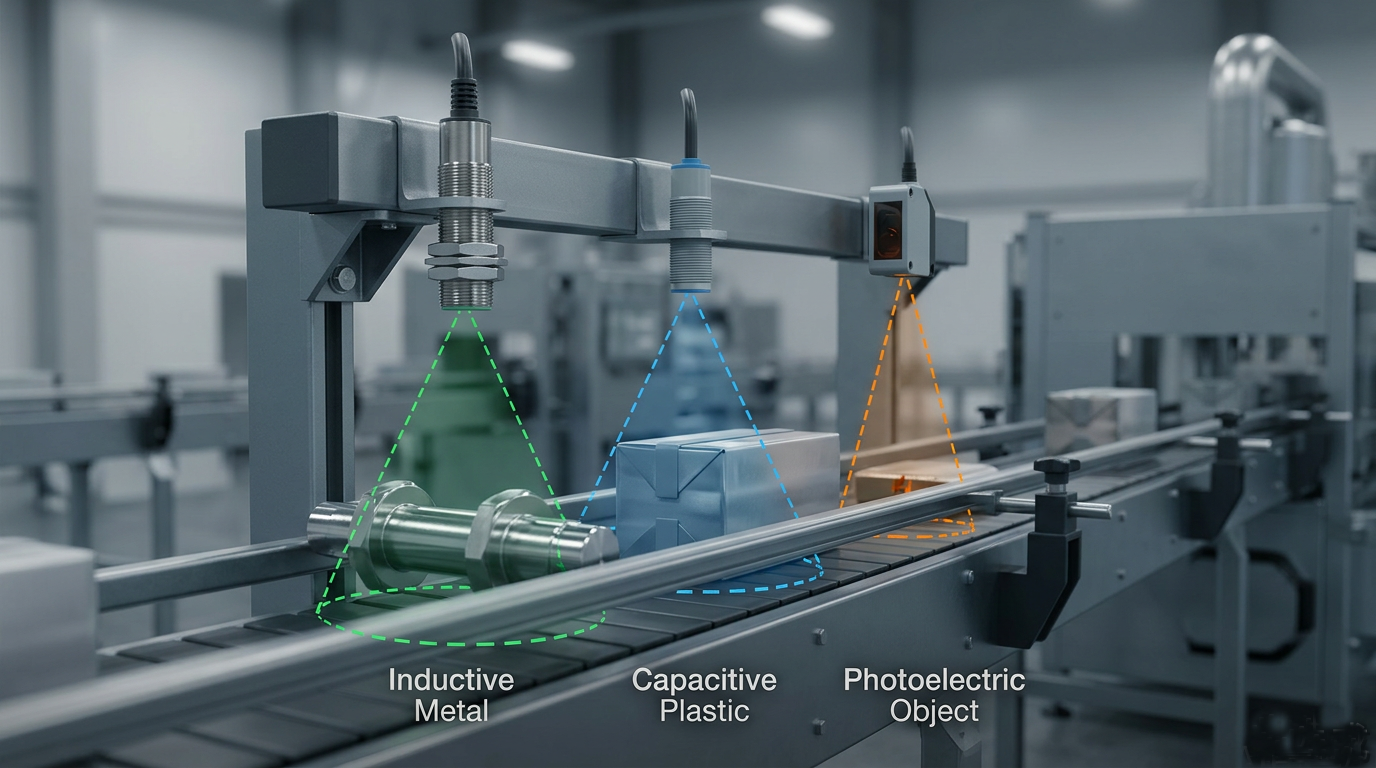
Magnetic metal targets take an inductive sensor, any conductor or dielectric body (plastic, glass, granules, liquid) takes a capacitive sensor, and transparent or distant targets take a photoelectric sensor.
Then decide mounting (flush or non-flush), distance against the standard target, and finally the electrical and environmental fit. Four decisions, in that order.
Monday morning, forty spec sheet rows
A new conveyor section needs presence detection. The machine builder opens a sensor catalog and sees forty columns: detection distance, flush and non-flush ranges, NPN and PNP output, response frequency, IP ratings, temperature windows, standard target sizes. Every column looks important, so the order goes out based on price and thread size alone.
This is where the catalog's own physics notes bite two weeks later: the sensor false-triggers whenever the carriage passes, or it never sees the aluminum foil liner at all. Both failures were predictable from the spec sheet - just not from the two columns most buyers read first.
The expensive sensor failure is rarely the one that dies. It is the one that works perfectly - on the wrong target, at the wrong distance, in the wrong mounting.
Why the obvious choice so often fails
The catalog is blunt about the physics: when the detected object is a non-magnetic metal, the action distance drops, and foil thinner than roughly 0.01 mm may not be detected at all by an inductive head. A sensor chosen for its 4 mm rating against a steel standard target will not deliver 4 mm on a thin aluminum web.
Mounting causes the other half of the failures. A non-flush (unshielded) head buried level in a steel plate sees the plate itself; opposing or parallel sensors mounted closer than the catalog's spacing guidance trigger each other. Both mistakes come from treating the housing as the decision instead of the installation.
So the fix is a fixed decision order. Start with the target, then the mounting, then the distance, then the electrics.
Step 1: Start with the target, not the sensor
Magnetic metal targets suit inductive sensors - the catalog families cover flush detection from 1 mm upward, with non-flush ranges from 1.5 mm out to 80 mm on large flat-mount types. Non-magnetic metal reduces the effective distance, and foil below about 0.01 mm is not guaranteed detection under the catalog's damping rule.
Non-metal targets change the physics family: capacitive sensors specify their detectable body as conductor and dielectric, which covers plastic, glass, granular material and liquids. Transparent objects, or anything beyond the reach of the inductive and capacitive ranges above, belong to photoelectric sensors - the catalog's diffuse types start at 7 cm, retroreflective types reach 5 m, and through-beam pairs run to 50 m, detecting transparent and opaque bodies alike.
Step 2: Flush or non-flush mounting
This is the trade. Flush (shielded) types sense through their metal surround and can be buried level with the machine face; non-flush (unshielded) types gain roughly double the range but need free space around the head. The catalog keeps both versions side by side - on the M12 family, 2 mm flush against 4 mm non-flush, same housing, same electricals.
Decide this second because it constrains everything after: a bracket with metal on three sides forces a flush type, and the flush range then decides whether the thread size grows. The catalog's mounting pages add the finishing rules - torque limits with a toothed washer, spacing between opposing heads to prevent mutual interference, and a lead-wire clip about 10 cm from the body.
Step 3: Distance against the standard target
With mounting settled, distance comes third: every catalog distance is specified against a standard target - a defined steel plate such as the SPCC iron 12 x 12 x 1 mm plate behind the ALJ12-4's 4 mm rating, or 18 x 18 x 1 mm behind the ASN04's 5 mm. Objects larger than the standard target hold the rated distance roughly constant; smaller or non-magnetic targets derate it. Read the standard target line before comparing ranges between brands.
Speed has its own column: response frequency spans 100-500 Hz on the DC cylindrical types and falls as low as 10 Hz on the largest flat-mount types. A 10 Hz sensor cannot resolve targets passing at 100 per second - match the frequency to your parts-per-second rate, not just the gap.
Step 4: Electrical and environmental fit
Now the electrics: supply family (DC 6-36 V, AC 90-250 V, or the universal 20-230 V AC/DC types), output form (NPN, PNP, two-wire, relay contact) and contact state (NO, NC, NO+NC). Then the environment: cylindrical metal housings carry IP67 and operate from -25 to +75 °C in the catalog's standard families, while large flat types trade to IP65 with resin housings - fine indoors, not for washdown.
Three built-ins are worth confirming on any datasheet you compare: reverse-connection protection, surge absorption and load short-circuit protection on the three-wire DC types. They are built into the three-wire DC types as standard and remove the two most common field failure modes.
The shortlist, in practice
Metal target within 4 mm, mounted in a threaded hole: the M12 non-flush ALJ12-4. Block mounting with about 5 mm of approach where a cylinder will not fit: the square ASN04. Transparent film, carton flaps or anything from 10 to 50 cm away: the M18 diffuse photoelectric AE3F-DS50 with its adjustable sensitivity.
One boundary: this guide covers switching sensors for presence detection. Position and level duties that need a proportional signal belong to analog-output types, covered separately.
Send us the target material, the required distance and the mounting constraints - we will return a shortlist with the exact output form and housing. Message us on WhatsApp at +86 186 5776 0640 or email joan@zm-ele.com, and we will reply with part numbers, not a catalog dump.
Have Questions?
Our technical team is ready to help you with sensor selection, application support, and custom solutions.
Contact UsRelated Articles
NPN vs PNP Sensor: How to Identify the Output Type
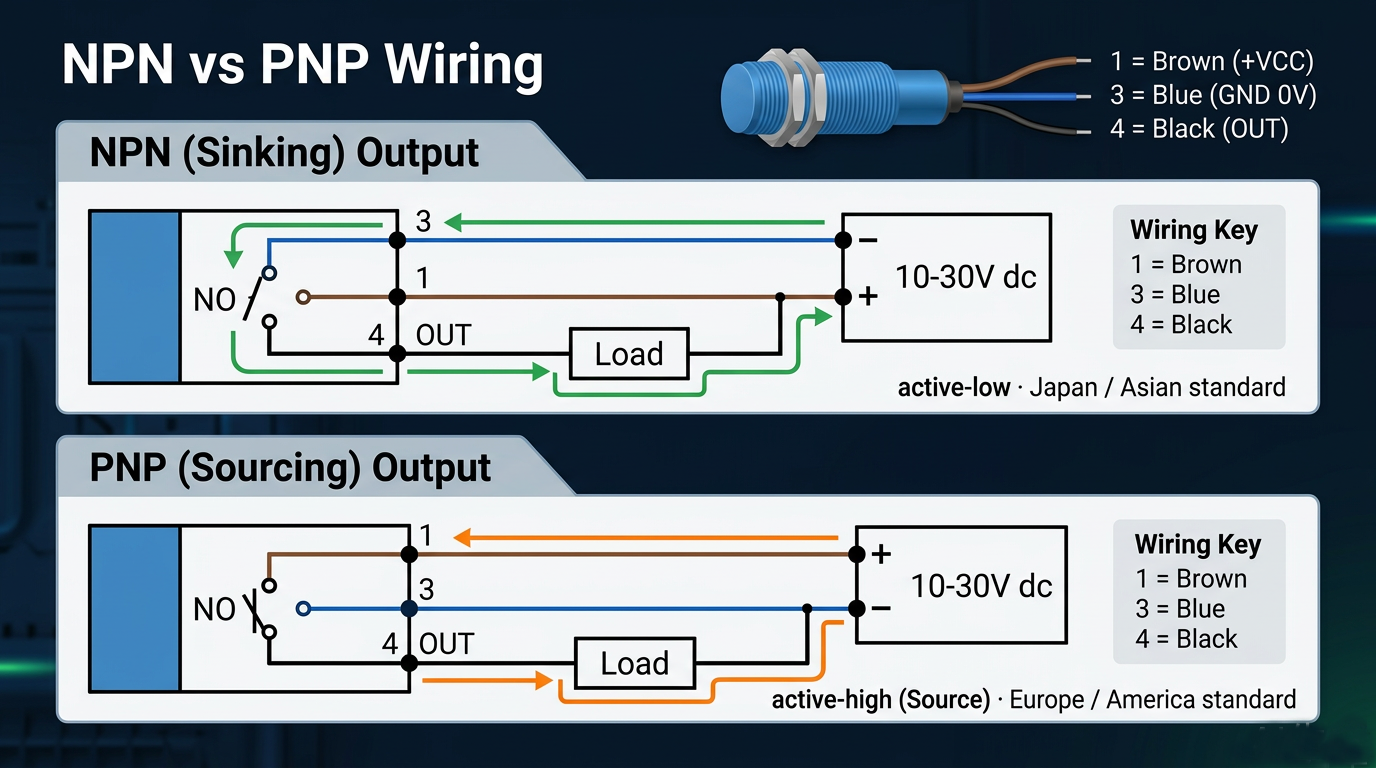
NPN sinks current to 0 V, PNP sources it from +V. Read the model code, confirm the three-wire convention, meter the signal wire - then match your PLC input card before ordering.
Read More
Capacitive Sensor Application Guide: What Materials and Distances It Covers
Capacitive sensors detect conductors and dielectric bodies alike - plastic, glass, granules, liquids. Where they beat inductive sensors, and the distance ranges you can expect from each family.
Read More
Which Devices Use Analog-Output Sensors, and How Do You Interface with Them?
4-20 mA current loops, 0-5 V and 0-10 V voltage outputs each have a load rule and a wiring habit. Where proportional displacement sensing earns its keep, and how to connect it without noise.
Read More