
Which Devices Use Analog-Output Sensors, and How Do You Interface with Them?

QUICK ANSWER
Any machine that needs a position number rather than an on/off edge uses an analog-output sensor: press and cylinder positioning, gap and thickness monitoring, level monitoring, and process loops. The catalog's linear displacement sensors output 4-20 mA current or 0-5 V / 0-10 V voltage on a 15-30 V DC supply.
The interface rules are load rules: current output tolerates 0-300 ohm; voltage output needs at least 2.2 k ohm. Get the load wrong and the reading flattens before a single wire is loose.
The line runs fine - the controller just cannot see position
A press station needs to know the ram is 3.2 mm from bottom stop, not merely that it passed a switch. A thickness check needs the deviation number, not an alarm after the tolerance is already blown. A switching proximity sensor answers only the second kind of question - it was never built to report where something is between its sensing face and its range limit.
That is the gap analog-output sensors fill. And the interfacing mistakes start immediately after purchase, because an analog sensor is the first device on the panel that cares about ohms, ripple and shielding as much as about detection.
A switching sensor fails loudly. An analog sensor fails quietly - the number just stops being true.
Current output or voltage output - the load decides
Start with the current types: the catalog's 4-20 mA outputs tolerate a load resistance of 0-300 ohm. The 4 mA zero point is the feature worth having: a live sensor reporting zero distance still sends 4 mA, so a reading of 0 mA means a broken wire, not a perfect measurement. That is why 4-20 mA is the default choice for runs longer than a panel and for anything that has to fail safely.
The voltage types then flip the logic: 0-5 V or 0-10 V output requires a load of at least 2.2 k ohm. Below that, the input's impedance drags the signal down and the scale compresses - a nominal 10 V full-scale signal can read well below 10 V. Voltage output suits short, clean runs into a dedicated analog input; current output suits everything else.
Both flavors in this catalog run on 15-30 V DC, hold a linear error of plus or minus 5% across the range, and draw up to 20 mA when idle - size the loop supply for the sensor plus the load, not just the load.
Interfacing without noise
So the wiring discipline is concrete. Wire the analog pair as twisted, shielded cable and ground the shield at one end only - grounding both ends turns the shield into an antenna loop. Keep the run out of the same trunk as AC power lines, the same hazard the catalog addresses for switching-sensor leads when power lines pass nearby.
Supply quality matters more than for switching types: the catalog limits allowable voltage undulation to 5%. A supply with visible ripple becomes ripple on the reading, and no firmware filter fully removes it. Check the ripple before blaming the sensor - it is a two-minute measurement that saves an afternoon of false diagnosis.
One more catalog detail that pays off: the output is a PNP-type analog signal, so the input side reads a driven voltage or receives a current depending on flavor - confirm the analog input card's accepted signal form before wiring, exactly as you would for a switching sensor's output logic.
The range ladder, and how to order
On the product side, the cylindrical XM series: XM18 covers 5 mm flush and 8 mm non-flush, XM24 covers 10 mm and 15 mm, XM30 covers 15 mm and 20 mm. The flat XMF10, XMF37 and XMF38 types run 15-40 mm flush and up to 50 mm non-flush. All detect metal targets, in plastic or metal housings rated IP54, operating from -10 to +70 °C.
A boundary to keep the choice honest: these are inductive linear sensors - the target stays metal, and the duty is displacement over tens of millimeters. Long-stroke positioning, non-metal media and sub-millimeter precision belong to other instrument classes entirely.
Tell us the measurement range, the supply voltage and whether your controller takes current or voltage. Message us on WhatsApp at +86 186 5776 0640 or email joan@zm-ele.com, and we will confirm the load compatibility and return the exact XM part number before you order.
Have Questions?
Our technical team is ready to help you with sensor selection, application support, and custom solutions.
Contact UsRelated Articles
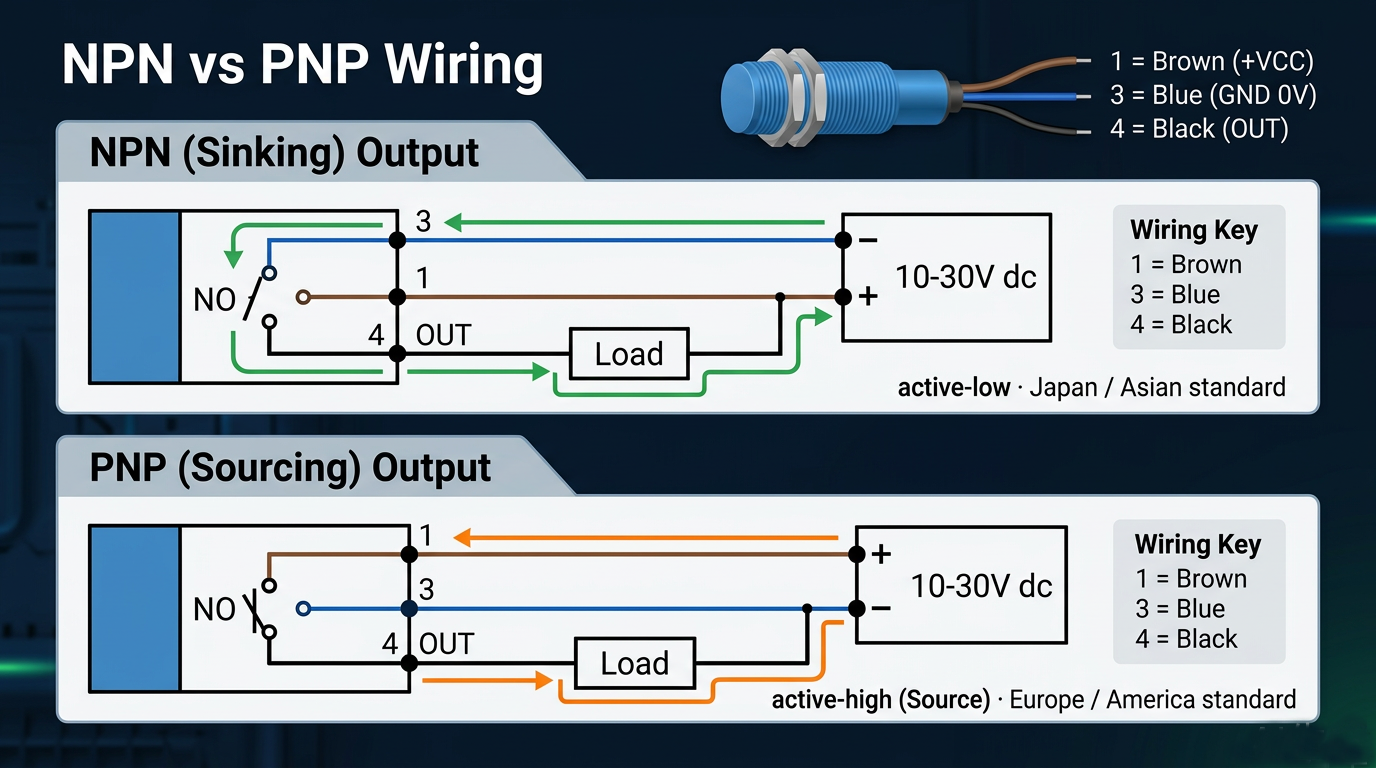
NPN vs PNP Sensor: How to Identify the Output Type
NPN sinks current to 0 V, PNP sources it from +V. Read the model code, confirm the three-wire convention, meter the signal wire - then match your PLC input card before ordering.
Read More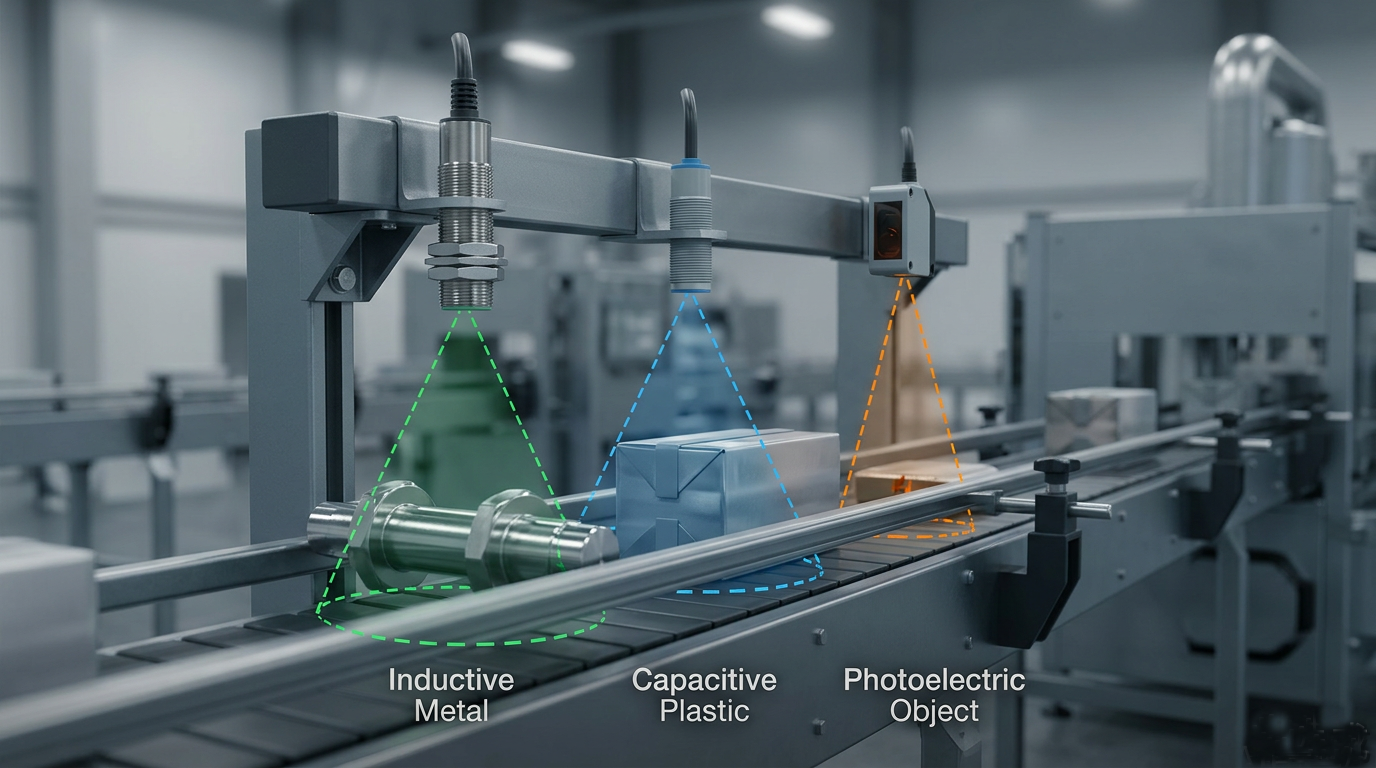
Sensor Selection Guide: How to Find the Best Fit for Your Application
Target material, mounting style, detection distance and environment decide which sensor survives on your line. A four-step walkthrough from spec sheet to part number.
Read More
Capacitive Sensor Application Guide: What Materials and Distances It Covers
Capacitive sensors detect conductors and dielectric bodies alike - plastic, glass, granules, liquids. Where they beat inductive sensors, and the distance ranges you can expect from each family.
Read More