
Capacitive Sensor Application Guide: What Materials and Distances It Covers

QUICK ANSWER
A capacitive sensor detects conductor and dielectric bodies - metal, plastic, glass, paper, granules and liquids. The catalog's cylindrical families cover flush ranges of 0-5 to 0-10 mm and non-flush 0-8 to 0-15 mm; the larger bodies reach 0-20 to 0-25 mm.
Response runs at 50 Hz on DC types and 20 Hz on AC types - built for level and presence duties, not high-speed counting.
The hopper runs dry and the machine keeps calling for material
A granule hopper empties at 14:00. The inductive sensor on the outside of the plastic wall never noticed - inductive sensing simply has nothing to say to a dielectric wall and a non-metal load. The feeder keeps running, the downstream machine starves, and the operator spends the afternoon digging granules out of the intake.
This is the gap capacitive sensing exists to fill, and it is concrete: the plastic wall itself, the granules behind it, the liquid level in a glass vessel, the carton on the conveyor - a capacitive face reacts to each of them.
Inductive sensors see metal. Capacitive sensors see the material your process is actually made of.
Why buyers avoid capacitive types - and when that fear is wrong
Here is the usual objection: if it reacts to any dielectric, dust and moisture will trigger it. The fear is not baseless - the sensing face genuinely does not distinguish plastic from a film of product buildup. But the catalog's answer is range discipline, not avoidance: the cylindrical families are built to detect through a wall or across a short air gap, and the flush ranges exist precisely so the sensor sees the medium, not the machine.
The practical rules follow from the physics. Mount the sensor so its face sees your target and as little background as possible; keep the face clean of adhering product, because buildup shifts the threshold; and remember the response limit - 50 Hz DC, 20 Hz AC - which disqualifies capacitive types for counting duties but is irrelevant for level and presence.
With the fear addressed, the real decision is distance and housing. That is where the catalog's series line up.
The distance ranges, family by family
Start with the cylindrical series: CM12 covers 0-4 mm; CM18 gives 0-5 mm flush and 0-8 mm non-flush; CM24 gives 0-8 mm flush and 0-12 mm non-flush; CM30 gives 0-10 mm flush and 0-15 mm non-flush. CM20 rounds out the middle of the cylindrical range at 0-10 mm non-flush.
The larger bodies then push further: CM34 reaches 0-20 mm, CM35 and the angular CMF37 reach 0-25 mm, and CM48 covers 0-20 mm. Supply is DC 6-36 V or AC 90-250 V across the series, with output currents of 200 mA DC and 300 mA AC on the main families.
Protection is rated per family: the catalog lists the CM18-CM30 cylindrical families at IP65 and the CM34 family at IP67, with a rated ambient of -25 to +70 °C across the series, in ABS or metal housings. The catalog also lists alternatives (LJC18A3, LJC24A3, E2K-X15M, E2K-C25) for lines standardized on other part numbers.
Choosing by application, not by range alone
So the application maps directly. Level through a non-metal wall: pick the flush range to match your wall position - a CM18 at 0-5 mm flush suits a thin-walled container, a CM30 at 0-10 mm flush suits thicker walls. Presence at a short air gap: the non-flush ranges add headroom, with CM24 or CM30 covering conveyor duties. Bulk level in a big hopper: the larger 0-20 to 0-25 mm bodies, mounted where the medium actually reaches.
Two boundaries worth stating. First, these are switching sensors - a capacitive type tells you level is high or low, not how high; proportional duties belong to analog-output sensors. Second, washdown and chemical-heavy areas exceed what IP65 ABS bodies are rated for; the catalog itself warns against strong alkali and acid environments for its sensing families.
Send us the medium, the wall thickness and the mounting position - we will point you at the exact CM series range and housing. Message us on WhatsApp at +86 186 5776 0640 or email joan@zm-ele.com, and we will return a part number with the NPN, PNP or two-wire output your panel expects.
Have Questions?
Our technical team is ready to help you with sensor selection, application support, and custom solutions.
Contact UsRelated Articles
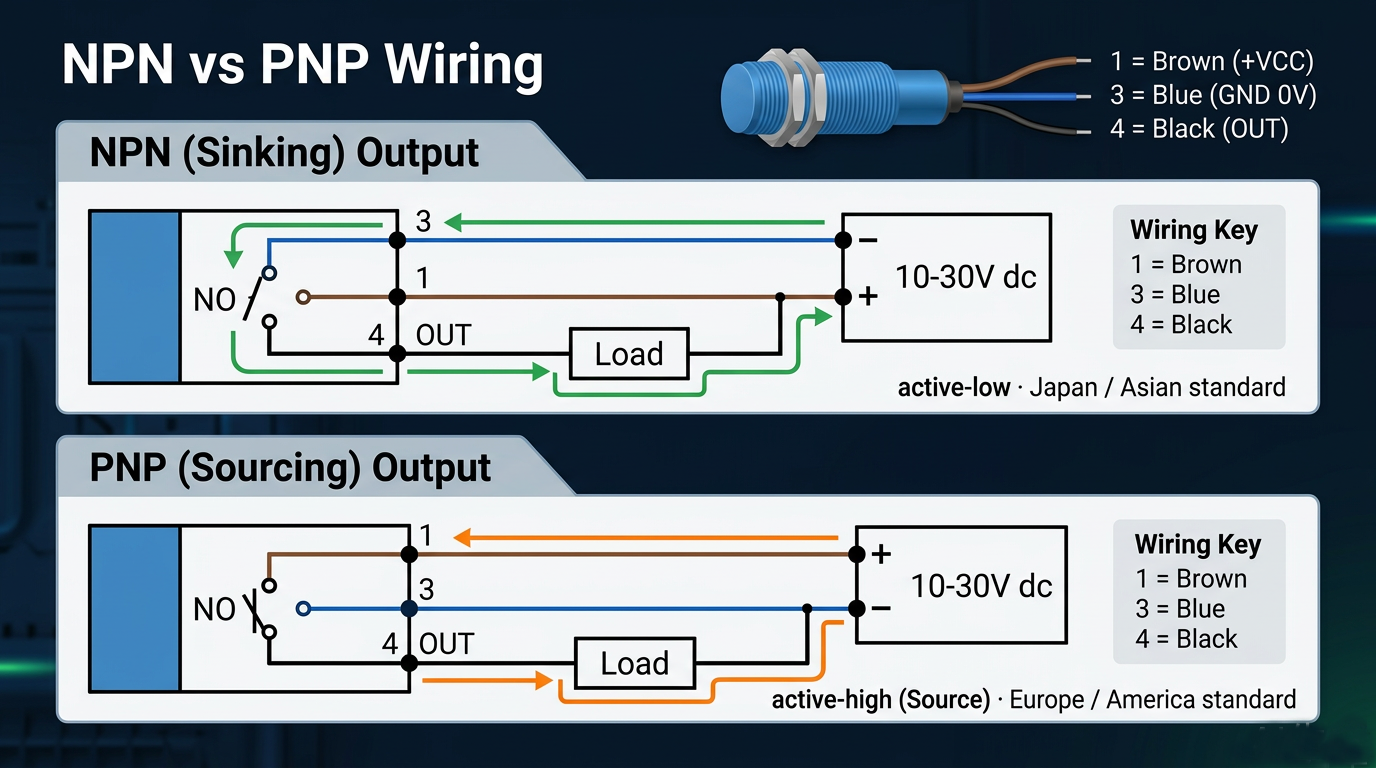
NPN vs PNP Sensor: How to Identify the Output Type
NPN sinks current to 0 V, PNP sources it from +V. Read the model code, confirm the three-wire convention, meter the signal wire - then match your PLC input card before ordering.
Read More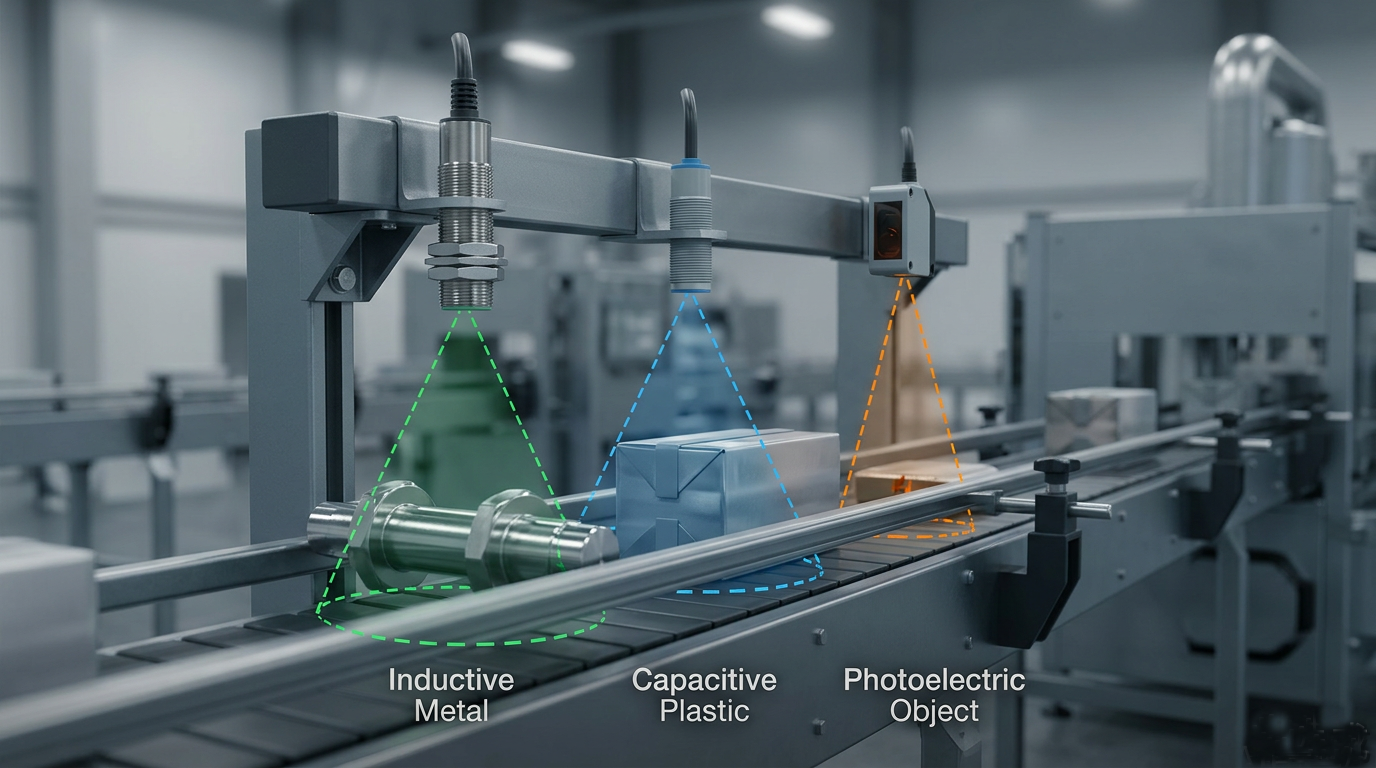
Sensor Selection Guide: How to Find the Best Fit for Your Application
Target material, mounting style, detection distance and environment decide which sensor survives on your line. A four-step walkthrough from spec sheet to part number.
Read More
Which Devices Use Analog-Output Sensors, and How Do You Interface with Them?
4-20 mA current loops, 0-5 V and 0-10 V voltage outputs each have a load rule and a wiring habit. Where proportional displacement sensing earns its keep, and how to connect it without noise.
Read More